Call Us
AI TRACKING
● REC 00:14:32
- Mon - Fri 10:00 - 18:00, Sat 10:00 - 15:00, Sunday - CLOSED
- Email: sales@israintech.com

-


WhatsApp
+92 321 1114772
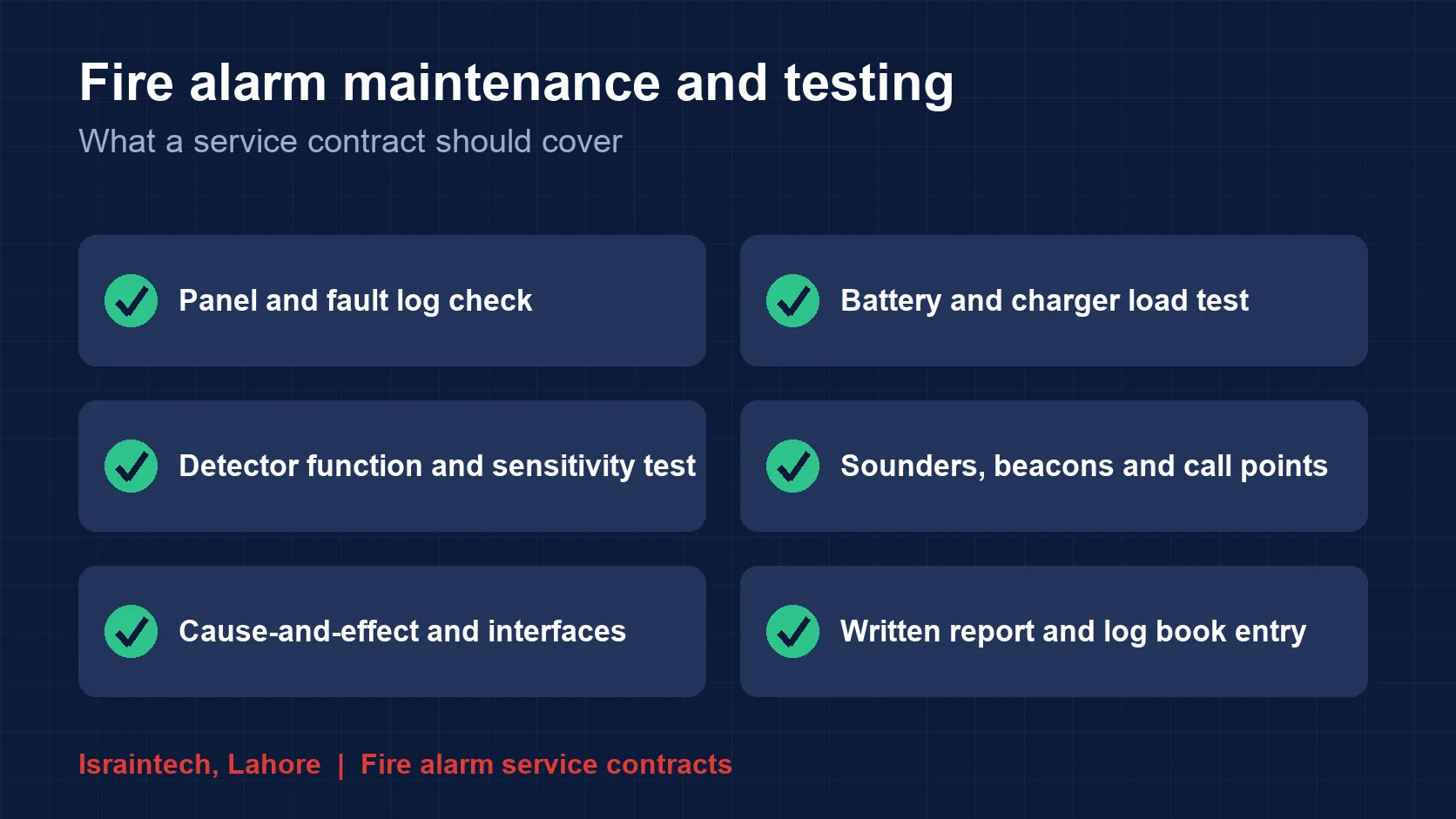
Fire Alarm Maintenance and Testing: What a Service Contract Should Cover
Installing a fire alarm is only half the job. Detectors collect dust, batteries age, buildings are altered and devices drift out of tune. A system that is never tested may look healthy on the panel and still fail when it is needed. This guide explains what proper fire alarm maintenance and testing involves, and what a fire alarm service contract should cover.
Why Fire Alarm Maintenance Matters
- Reliability: a tested system works on the day. An untested one may not.
- Fewer false alarms: dirty or poorly placed detectors are the biggest cause of nuisance alarms, and repeated false alarms teach people to ignore the real one.
- Battery health: if the mains fails during a fire, the batteries have to carry the system. Capacity drops with age and heat.
- Insurance and compliance: insurers and consultants expect test records, and a clean log book shows the system has been looked after.
- Changes to the building: new partitions, racking, machinery and use changes can leave areas uncovered or detectors blocked.
What Is Checked at a Service Visit
1. Control panel and fault log
The engineer reviews the event and fault history, checks the panel display and indicators, confirms the time and date, and clears recorded faults after fixing the cause.
2. Batteries and power supply
Batteries are load-tested, not just looked at. The charger, mains supply and standby capacity are checked, and weak batteries are replaced before they fail.
3. Detectors
A sample or all detectors are functionally tested with the correct test agent for their type, and their analogue values are read from the panel on addressable systems. Dirty or drifting detectors are cleaned or replaced.
4. Manual call points, sounders and beacons
Every call point is operated in rotation, and sounders and beacons are checked for operation and audibility, including in noisy or remote areas.
5. Interfaces and cause-and-effect
Links to sprinklers, ventilation, doors, lifts and access control are tested against the cause-and-effect plan to confirm each one still does what it should.
6. Report and log book
The engineer records what was tested, what was found and what was repaired, signs the log book and gives you a written report with recommendations.
What You Should Do Between Visits
- Test one manual call point every week, using a different one each time, and record it in the log book.
- Record every alarm, fault and false alarm with the date, cause and action taken.
- Keep detectors and call points clear of stored goods, paint and covers.
- Report building changes (new rooms, partitions, racking, change of use) so coverage can be reviewed.
What a Fire Alarm Service Contract Should Cover
A service contract, often called an AMC (annual maintenance contract), should be clear and written down. Look for:
- A fixed schedule of visits per year, matched to the standard the system follows.
- A defined scope: panel, batteries, detectors, call points, sounders, interfaces.
- Response times for faults and emergency call-outs (an SLA).
- How spare parts and replacements are handled.
- Reports and log book updates after every visit.
- Named, trained engineers who know the brand of your system.
- Advice on false alarms, extensions and upgrades.
Our maintenance contracts and SLA cover fire alarm systems alongside CCTV, access control and attendance systems, so one provider looks after your building. If you are still choosing a system, read our guide to addressable vs conventional fire alarm systems, and for large industrial sites see fire alarm systems for factories and warehouses.
Talk to Israintech
Israintech installs and services fire alarm systems in Lahore using brands including Honeywell, Gent and Global. See our fire alarm system page, or contact us to arrange a service visit or a free site assessment.
Frequently Asked Questions
How often should a fire alarm system be tested?
The standard your system was designed to sets the minimum. In practice a responsible person tests a call point weekly, and a competent engineer carries out scheduled functional tests, battery checks and a full inspection through the year. A service contract sets the schedule so nothing is missed.
What does a fire alarm service contract include?
Scheduled visits, functional testing of detectors, call points, sounders and interfaces, a battery and charger check, cleaning or replacement of dirty detectors, a written report, an updated log book and a defined response time for faults and call-outs.
Why does my fire alarm keep giving false alarms?
The usual causes are dust or insects in detectors, steam or cooking fumes, a wrong detector type for the room, ageing devices and badly adjusted sensitivity. A service visit finds the cause, and often a different detector type or a clean fixes it.
Do batteries in the fire alarm panel need replacing?
Yes. Standby batteries age and lose capacity, so they are load-tested at every service and replaced on a schedule, typically every few years, based on the test result and the manufacturer’s guidance.
Who should keep the fire alarm log book?
The person responsible for the building, with entries made by both staff (weekly tests, alarms, faults) and the service engineer (visits, repairs, changes). It is the first thing an insurer or inspector asks to see.