Call Us
AI TRACKING
● REC 00:14:32
- Mon - Fri 10:00 - 18:00, Sat 10:00 - 15:00, Sunday - CLOSED
- Email: sales@israintech.com

-
-


WhatsApp
+92 321 1114772
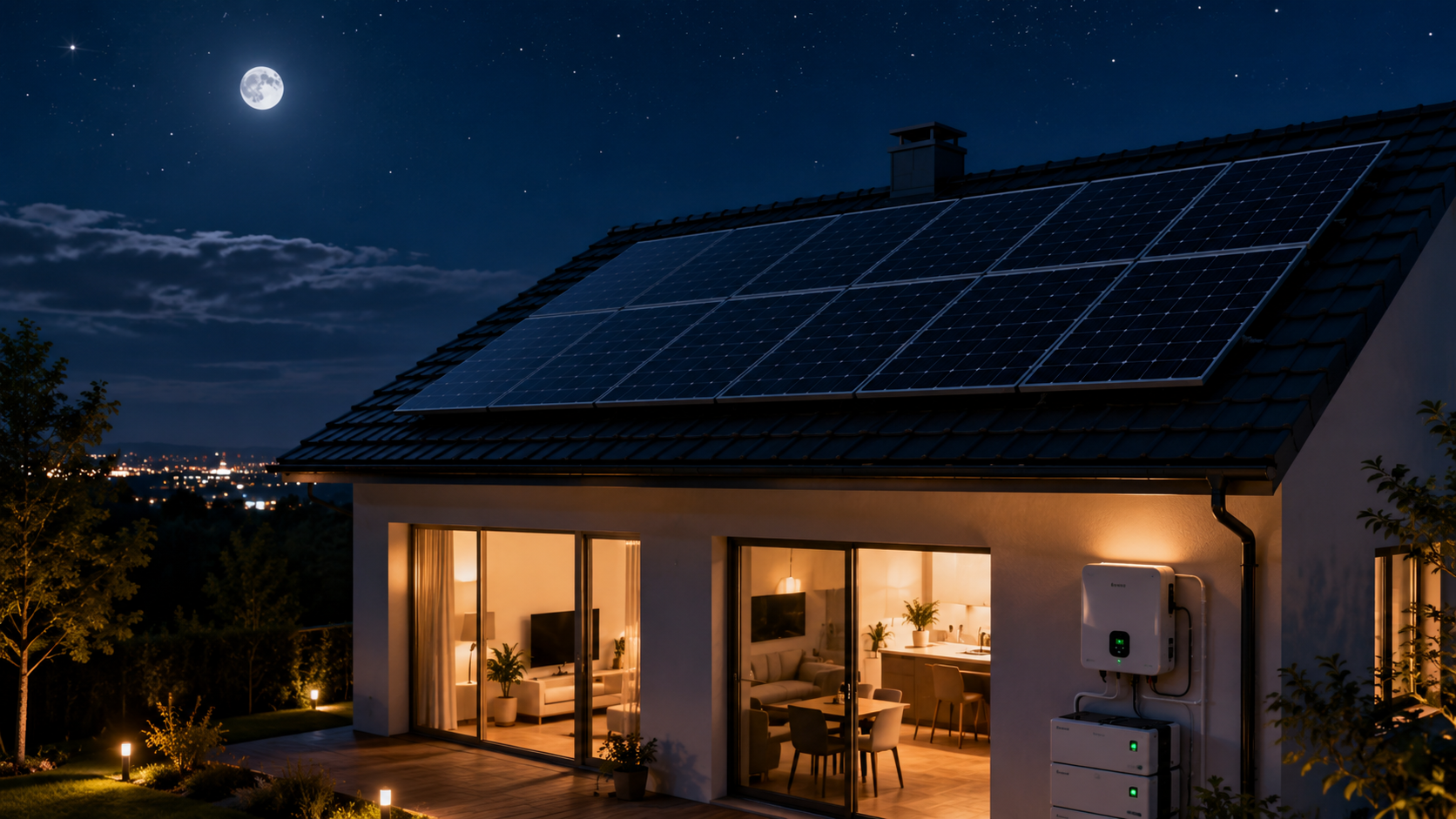
If you’ve just invested in a solar system, or you’re about to, there’s a good chance this question has crossed your mind at 11 PM while your lights are still on: do solar panels work at night? It’s one of the most searched solar questions in Pakistan, and for good reason. Load-shedding doesn’t stop when the sun goes down, and neither does your need for electricity.
The short answer is no, solar panels don’t generate electricity at night, but that doesn’t mean your home goes dark. In this guide, we’ll explain exactly why panels stop producing after sunset, what actually keeps your lights, fans, and Wi-Fi running at night, and what the buzz around “night solar panels” really means. By the end, you’ll know exactly how to plan a system that works around the clock, not just during daylight.
How Solar Panels Actually Generate Electricity?
To understand why night is a problem, it helps to understand how solar panels work in the first place. Solar panels are made of photovoltaic (PV) cells, usually silicon-based, which convert sunlight into electricity through something called the photovoltaic effect.
Here’s the simple version: sunlight is made up of tiny packets of energy called photons. When these photons strike the surface of a solar cell, they knock electrons loose from the silicon atoms. This movement of electrons creates a flow of direct current (DC) electricity, which your solar inverter then converts into alternating current (AC), the type of electricity your home appliances use.
The keyword here is photons. Without sunlight, there are no photons hitting the panel, no electrons get knocked loose, and no electricity is produced. This is exactly why solar panels go quiet after sunset.
So, Why Don’t Solar Panels Work at Night?
It comes down to one simple fact: solar panels need light, not just daytime. A few important points to understand:
- No sunlight = no photon activity. Moonlight is simply reflected sunlight and is far too weak (about 400,000 times dimmer than direct sunlight) to generate any meaningful electricity.
- Panel output drops well before full darkness. Even during early evening or heavy cloud cover, output can fall to a small fraction of peak capacity long before the sun actually sets.
- This is normal, not a defect. Every standard solar panel on the market today, monocrystalline, polycrystalline, or thin-film, behaves this way. It’s physics, not a product flaw.
| Condition | Approximate Panel Output |
| Full direct sunlight (midday) | 100% |
| Cloudy/overcast daytime | 10–25% |
| Dawn/dusk (low sun angle) | Under 10% |
| Moonlight (clear full moon) | Effectively 0% (unmeasurable) |
| Complete darkness | 0% |
Then How Do Solar Homes Have Power at Night?
This is where most of the confusion clears up. Your solar panels don’t need to work at night; your system does the work of storing or sourcing electricity for you. There are three main ways this happens:
1. Battery Storage (Off-Grid & Hybrid Systems)
During the day, your panels typically generate more electricity than your home needs. Instead of letting that extra energy go to waste, a battery bank stores it for later use. Once the sun goes down, your inverter automatically switches to drawing power from the battery, keeping your appliances running seamlessly.
This is the most popular setup in Pakistan right now, especially in areas with frequent load-shedding, because it makes you largely independent of the national grid after dark.
2. Net Metering (On-Grid Systems)
If you don’t have a battery, a net-metered solar system sends your excess daytime electricity back into the national grid. In return, WAPDA/your DISCO credits your account for those exported units. At night, you draw electricity back from the grid as usual, but thanks to the credit you earned during the day, your bill reflects the net usage, which can be dramatically lower.
3. Hybrid Systems (Best of Both)
A hybrid solar system combines battery storage with a grid connection. During the day, your home runs on solar. Excess energy charges your battery first; only after the battery is full does surplus get exported to the grid (where net metering applies). At night, you draw from your battery first, and only pull from the grid once the battery is depleted. This gives you backup power during outages and the bill-saving benefits of net metering.
| System Type | Works at Night? | Needs Grid? | Needs Battery? | Best For |
| Off-Grid | Yes, via battery | No | Yes | Areas with no/unreliable grid access |
| On-Grid (Net Metering) | Yes, via grid credit | Yes | No | Homes wanting lower bills, grid is reliable |
| Hybrid | Yes, via battery + grid | Yes | Yes | Homes wanting backup power and bill savings |
What About “Night Solar Panels”? Are They Real?
You may have come across headlines about panels that can supposedly generate electricity after dark. This isn’t science fiction, but it’s also not something you can install on your rooftop just yet.
The technology is often called thermoradiative or anti-solar panels. Instead of absorbing sunlight, they work in reverse: they release heat that the Earth’s surface radiates upward into the cold night sky, and this temperature difference generates a small electrical current. Researchers have successfully demonstrated the concept in labs, producing tiny amounts of power.
Here’s the honest, no-hype status of this technology as of today:
- Still experimental: Largely confined to research labs and prototypes, not commercial products.
- Extremely low output: Current versions generate a fraction of what a standard solar panel produces in daylight.
- Not commercially available in Pakistan: Despite marketing claims you may see online, there is no proven, mass-market “night solar panel” you can buy and install for meaningful household power today.
- Promising for the future: As materials and efficiency improve, this could eventually complement daytime solar and battery systems, but it’s not a near-term replacement for either.
Our advice: don’t wait for night solar technology to mature. Battery storage and net metering already solve the nighttime power problem effectively, affordably, and reliably today.
How to Design a Solar System That Covers You Day and Night?
If your goal is uninterrupted power, here’s what actually matters when planning your system:
- Calculate your evening/night load first. List what you actually need to run after sunset: lights, fans, Wi-Fi router, fridge, TV, and add up the wattage.
- Size your battery to that load, not your total home load. You don’t need to store your entire day’s consumption; just enough to comfortably cover your evening hours plus a safety margin.
- Oversize your panel array slightly. Your panels need to do double duty: power your home during the day and recharge your battery for the night. A slightly larger array prevents your battery from running short.
- Choose a hybrid inverter if you want flexibility. It lets you draw from the battery first and fall back to the grid automatically, so you’re never left without power.
- Get net metering approved if you’re grid-connected. Even with a battery, net metering ensures any true excess energy still earns you bill credits instead of going to waste.
Common Myths About Solar Panels and Nighttime
| Myth | Reality |
| “Solar panels are useless once the sun sets.” | The panels stop, but your battery/grid setup keeps power flowing. |
| “Moonlight can charge solar panels.” | Moonlight is far too weak to produce usable electricity. |
| “You need to buy expensive new panels to get night power.” | A properly sized battery or net metering connection solves this with your existing panels. |
| “Night solar panels are already sold in Pakistan.” | This technology remains experimental and isn’t a viable household solution yet. |
| “Cloudy nights ruin solar systems.” | Clouds affect daytime charging slightly, but properly sized batteries still cover your night-time needs. |
Final Thoughts
So, do solar panels work at night? No, and that’s completely normal. What matters is how your overall solar system is designed around that fact. With the right combination of battery storage, net metering, or a hybrid setup, your home can stay powered 24/7, even through load-shedding and after sunset.
At Israintech, we don’t just sell panels; we design complete day-and-night solar solutions tailored to your household’s real usage patterns. If you’re planning a system and want to make sure your evenings and nights are covered too, our team can carry out a free site assessment and recommend the right battery and inverter combination for your home.
FAQs
Do solar panels produce any electricity at night at all?
No. Standard solar panels require direct sunlight (photons) to generate electricity and produce effectively zero output after sunset, including under moonlight.
How do I get electricity at night if I have solar panels?
Through battery storage (stored daytime energy), net metering (grid credit for exported daytime energy), or a hybrid system combining both.
Are night solar panels available to buy in Pakistan?
Not yet in any commercially viable, mass-market form. The technology exists in research labs but doesn’t currently produce enough power for household use.
How big a battery do I need to run my home at night on solar?
It depends on your evening/night load. A typical home running lights, fans, a fridge, and Wi-Fi for 6–8 hours usually needs a battery bank in the 200Ah–400Ah range, but this should be calculated based on your specific appliances.
Is net metering better than a battery for night-time power?
Net metering is more affordable upfront and works well if your grid supply is reliable. A battery is better if you experience frequent load-shedding, since it gives you power even when the grid is down.

Leave A Comment