Call Us
AI TRACKING
● REC 00:14:32
- Mon - Fri 10:00 - 18:00, Sat 10:00 - 15:00, Sunday - CLOSED
- Email: sales@israintech.com

-
-


WhatsApp
+92 321 1114772
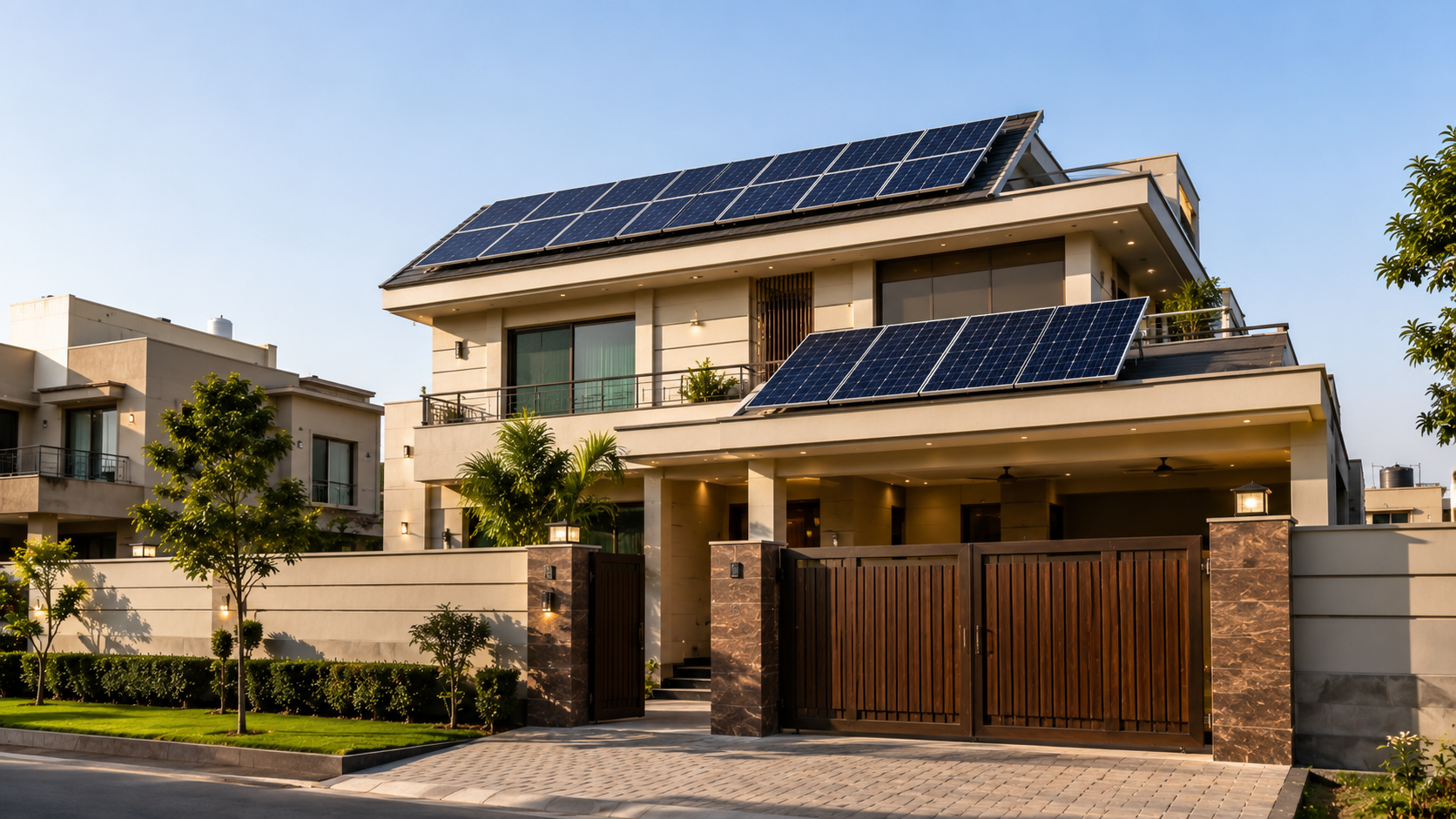
A 10kW solar system is one of the most popular choices for large households, joint family homes, and small businesses in Pakistan, big enough to run multiple ACs, run the whole house comfortably, and still qualify for solid net metering savings. But before you commit to a size, there’s one practical question every buyer asks first: how many solar panels are actually required for a 10kW system?
The answer isn’t a single fixed number; it depends entirely on the wattage of the panels you choose. In this guide, we’ll break down the exact panel count for every common wattage available in Pakistan, how much roof space you’ll need, how much electricity a 10kW system actually produces, and what it typically costs, so you can walk into a conversation with any installer already knowing what to expect.
The Quick Answer
For a standard 10kW solar system in Pakistan, you’ll typically need between 17 and 34 solar panels, depending on the wattage of the panels you select. Higher-wattage panels mean fewer panels and less roof space; lower-wattage panels mean more panels but a slightly lower per-watt cost in some cases.
How Many Solar Panels Are Required for 10kW? (By Panel Wattage)
Here’s the full breakdown so you can match it to whatever panels your installer is quoting:
| Panel Wattage | Panels Needed for 10kW | Approx. Roof Space Required |
| 300W | 33 – 34 panels | ~1,650 sq. ft. |
| 330W | 30 – 31 panels | ~1,550 sq. ft. |
| 400W | 25 panels | ~1,250 sq. ft. |
| 450W | 22 – 23 panels | ~1,150 sq. ft. |
| 540W | 18 – 19 panels | ~950 sq. ft. |
| 585W | 17 – 18 panels | ~900 sq. ft. |
Most Pakistani installers today recommend 540W–585W Tier-1 monocrystalline panels, since they offer the best balance of efficiency, price per watt, and roof space savings, which is why the “18-panel 10kW system” has become the industry standard reference point.
The Simple Formula Behind These Numbers
If you want to calculate this yourself for any panel wattage, the formula is straightforward:
System size (in watts) ÷ Panel wattage = Number of panels
Example with 550W panels: 10,000W ÷ 550W = 18.18 → rounded up to 18 panels
Example with 400W panels: 10,000W ÷ 400W = 25 → 25 panels
Installers usually round up rather than down, since it’s better to have a small buffer of extra capacity than to fall short of your target system size.
How Much Roof Space Do You Actually Need?
Roof space is often the deciding factor for homeowners choosing between fewer high-wattage panels or more lower-wattage ones. Each standard panel takes up roughly 45–50 square feet of space, including gaps for mounting and airflow.
| Panel Wattage | Panels Needed | Roof Space Needed |
| 585W (fewer, larger panels) | 17 – 18 | ~900 sq. ft. |
| 400W (mid-range) | 25 | ~1,250 sq. ft. |
| 300W (more, smaller panels) | 33 – 34 | ~1,650 sq. ft. |
If your rooftop space is limited, going with higher-wattage panels is almost always the better choice — you get the same 10kW output using nearly half the roof area compared to older, lower-wattage panels.
How Much Electricity Does a 10kW System Actually Produce?
Panel count is only half the picture; what matters most is how much usable electricity your system generates day to day. In Pakistan’s average sunlight conditions, a properly installed 10kW system typically produces:
| Output Period | Estimated Units (kWh) |
| Per day | 34 – 50 units |
| Per month | 1,000 – 1,500 units |
This is generally enough to comfortably run a large household running 2–3 inverter ACs, along with lights, fans, refrigerators, a washing machine, and other everyday appliances, while still leaving room to export surplus units back to the grid under net metering.
What Can a 10kW Solar System Actually Run?
To put those numbers into everyday context, here’s roughly what a 10kW system can support:
- 2 to 3 inverter air conditioners (1.5 ton each), running 6–8 hours during summer
- Full household lighting and fan load
- Refrigerator(s) and freezer running continuously
- Washing machine, iron, and kitchen appliances
- Wi-Fi router, TVs, and general electronics
This makes 10kW a popular sweet spot for large family homes, guest houses, small clinics, and small commercial setups — big enough to meaningfully cut or eliminate a heavy electricity bill, without stepping into full commercial-scale system territory.
System Type Also Affects What Else You’ll Need
Panel count is the same regardless of system type, but the rest of your setup changes significantly:
| System Type | Panels Needed | Batteries Required? | Best For |
| On-Grid (Net Metering) | Same panel count | No | Homes with reliable grid connection, focused on bill savings |
| Hybrid | Same panel count | Yes (backup during outages) | Homes wanting savings and load-shedding backup |
| Off-Grid | Same panel count | Yes (larger bank) | Areas with no or unreliable grid access |
For a hybrid or off-grid 10kW setup, you’ll typically need around 6 batteries of 300Ah at 24V, or 3 batteries of 300Ah at 48V, though this depends on your evening/night load and desired backup duration.
Estimated Cost of a 10kW Solar System in Pakistan
Prices shift with panel brand, inverter quality, and battery inclusion, but here’s a realistic 2026 ballpark:
| System Type | Approx. Price Range (PKR) |
| On-Grid (no battery) | 950,000 – 1,300,000 |
| Hybrid (with battery backup) | 1,200,000 – 1,450,000 |
| Off-Grid (full battery bank) | 1,400,000+ |
These figures typically include panels, inverter, mounting structure, wiring, breakers, and installation. Net metering documentation and DISCO processing costs may be included or billed separately depending on your installer, so it’s worth confirming this upfront.
Factors That Can Change Your Exact Panel Count
| Factor | Effect on Panel Count |
| Panel wattage chosen | Higher wattage = fewer panels for the same 10kW target |
| Panel efficiency/brand | Lower-efficiency panels may need slight oversizing |
| Roof shading or orientation | Poor sun exposure may require a small buffer of extra panels |
| Inverter compatibility | Panel string configuration must match inverter’s input specs |
| Future expansion plans | Some homeowners size slightly above 10kW to leave room to grow |
Common Mistakes to Avoid
- Choosing panel wattage based on price alone: Cheaper, lower-wattage panels often mean significantly more roof space and more mounting hardware, which can offset the savings.
- Not confirming inverter compatibility: Your inverter’s input voltage and string configuration must match your panel count and wiring layout.
- Skipping a proper roof survey: Actual usable roof space, shading, and structural load capacity all affect what’s realistically achievable.
- Ignoring net metering approval timelines: This process takes time, so it’s best started early alongside your installation.
Final Thoughts
So, how many solar panels are required for 10kW? For most Pakistani homes, that means 17 to 18 panels if you go with 540W–585W Tier-1 panels, the current industry standard, or up to 33–34 panels if you opt for older, lower-wattage panels. Either way, a properly designed 10kW system can comfortably power a large household, run multiple ACs, and deliver meaningful savings through net metering.
Since your exact panel count, roof layout, and battery needs depend on your specific home and usage pattern, it’s always worth getting a professional site assessment before finalizing your system. Israintech’s solar team can evaluate your rooftop, recommend the right panel wattage and inverter combination, and handle your net metering documentation from start to finish.
FAQs
How many solar panels do I need for a 10kW solar system?
Typically 17–18 panels if using 540W–585W panels, or up to 33–34 panels with older 300W panels. The exact count depends on the wattage you choose.
How much roof space is needed for a 10kW solar system?
Around 900 to 1,650 square feet, depending on panel wattage — higher-wattage panels need significantly less space.
How many units does a 10kW solar system produce per month?
On average, 1,000 to 1,500 units (kWh) per month, depending on sunlight hours, panel efficiency, and installation quality.
How many ACs can a 10kW solar system run?
A well-designed 10kW system can typically support 2 to 3 inverter air conditioners (1.5 ton each) along with regular household appliances.
Is a 10kW solar system enough for net metering?
Yes. A 10kW system is a popular and well-suited size for net metering, since it typically generates more electricity than an average household consumes during the day, allowing surplus units to be exported to the grid for bill credit.

Leave A Comment